Short Answer: Who's Who Among Carnelian, Red Agate, and Red Jasper
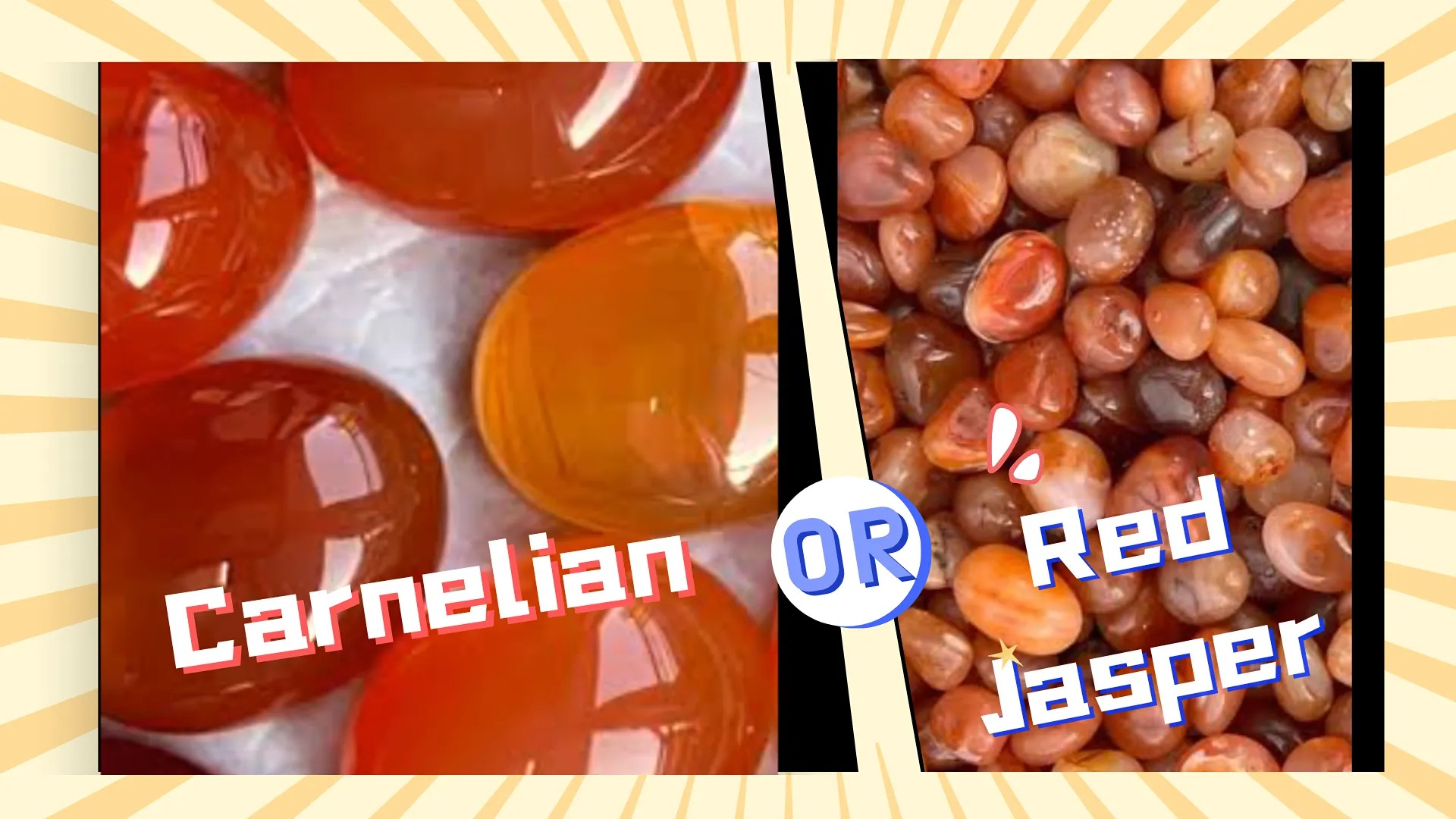
Most people arrive here with one question, and it comes in two shapes: "carnelian vs red jasper" and "red agate vs red jasper." In traditional naming, carnelian is itself often called red agate. That is why the two questions tend to collapse into one, and why carnelian agate is not two stones but one stone with two names.
Here is the fastest way to tell the three apart:
- If the stone does not let light through, it is red jasper.
- If light passes through it and there are no bands, it is carnelian.
- If light passes through it and you can see bands, it is red agate.
Banding is the tell for agate. Translucency is the tell for carnelian. Jasper has neither: it stays opaque and even.
Let's Start With the Name: Is Carnelian an Agate?
Short answer: in traditional naming, yes, with an asterisk.
Carnelian's older trade names include "red agate," "orange chalcedony," and "cornelian," and the two names have been used interchangeably in the gem trade for centuries. Strictly speaking, the definition of agate includes banding, so a red chalcedony with even color and no bands is usually called carnelian instead. The overlap lives in the naming, not in the stone.
"Jasper" is looser still. In older literature, almost any opaque, colored chalcedony could be called jasper. Modern gemology separates jasper from chalcedony by translucency and texture, which is why older sources often contradict each other. "Sard," meanwhile, is a related name rather than a synonym: sard sits at the browner, deeper end of the same range, while carnelian tends toward brighter orange-red.
So is carnelian an agate? Is carnelian the same as red agate? Why is carnelian called red agate? This section exists to answer all three. One more stone belongs to this family, our South Red Agate. And if the pair you actually want to compare is red jasper and red agate, we cover that separately in Red Jasper vs Red Agate.
What Is Red Jasper?
Red jasper is an opaque variety of microcrystalline quartz, usually grouped with the chalcedony family. Its color comes from scattered iron oxide, mainly hematite, and it runs from brick red to brownish red.
Visually it does three things at once. It blocks light completely, even along its thinnest edge. Its surface is matte and slightly earthy rather than polished. And it often carries faint, irregular streaks that look like soil rather than defined banding.
It is not a soft stone either. Red jasper sits at 6.5 to 7 on the Mohs scale, hard enough to work with, which is why it was shaped into blades, scrapers, and arrowheads in the Paleolithic period.
In our store, red jasper carries the name Stone of Perseverance. For the symbolism side, see our Red Jasper bracelet meaning guide, or go straight to the Red Jasper bracelet.
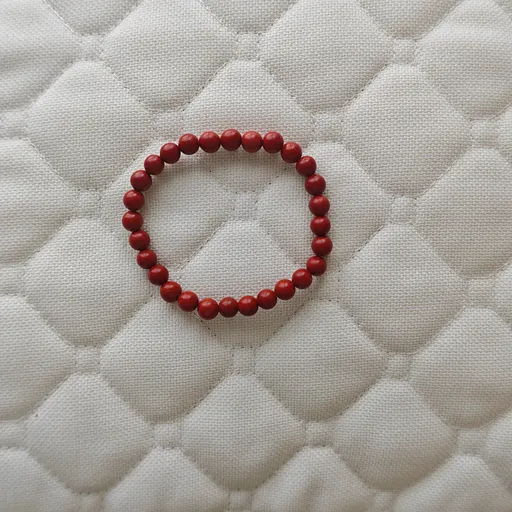
What Is Carnelian?
Carnelian is a translucent variety of chalcedony, colored by the same family of iron oxides. The difference is density: carnelian holds far fewer of the light-scattering inclusions that make jasper opaque. With less in the way, light passes through the stone's thinner edges, and the result is a soft orange glow.
Its color range is wider than red jasper's. Carnelian moves from pale yellow through orange and orange-red into a deep red-brown, and at the same size it generally reads brighter, warmer, and clearer than jasper.
Carnelian's history runs through the ancient world. In Egypt and Rome it was cut into seals and amulets, and because it is hard enough to take a fine polish, it became one of the most common stones for intaglio carving and signet rings.
In our store, carnelian carries the name stone of expression, and it is associated with action and speaking up. See the Carnelian bracelet.
Side by Side
Red Jasper | Carnelian | |
|---|---|---|
Mineral family | Microcrystalline quartz, often grouped with the chalcedony family | Chalcedony |
Color source | Scattered iron oxide | Iron oxide, with fewer light-scattering inclusions |
Transparency | Opaque | Translucent at the edges |
Color | Brick red to brownish red | Pale yellow, orange, orange-red, deep red-brown |
Surface | Matte, earthy | Vitreous to waxy, brighter when polished |
Texture | Faint, soil-like streaks | Usually even, with cloudy areas and subtle zones |
Mohs hardness | 6.5 to 7 | 6.5 to 7 |
Five Elements | Fire | Fire |
Intention | Endurance, grounding, holding steady | Motivation, expression, forward motion |
Store name | Stone of Perseverance | Stone of Expression |
Read the table and one row does most of the work: transparency. Red jasper and carnelian share a color family, a mineral family, and a hardness range. They part ways on how the stone handles light.
Note that hardness row. Neither stone is harder than the other, so no scratch test will separate them. Anyone who claims one is more durable is not reading this off the mineralogy.
How to Tell Them Apart: Five Tests Without Any Tools
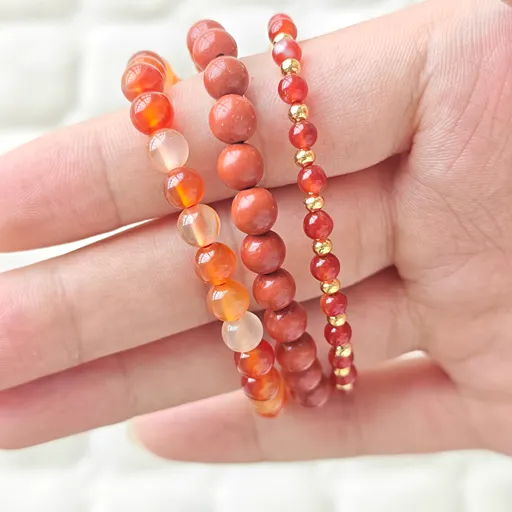
1. The light test. This is the decisive one. Hold the bead up to a strong light, and a phone flashlight is enough. Carnelian shows a warm orange glow through its thinner edges. Red jasper blocks the light, even at its thinnest point.
2. Tone. Carnelian reads orange-red, bright and warm. Red jasper reads brick red or brownish red, earthier and heavier.
3. Surface. Carnelian takes a brighter finish, closer to glass or wax. Red jasper stays matte and muted.
4. Texture. Carnelian is usually even in color, with cloudy patches and subtle zones. Red jasper often shows faint, irregular streaks. Those are not the clean bands of an agate.
5. Dye check. A natural stone varies gently across its surface. A dyed one looks too even and too saturated, and its color pools around cracks and drilled holes.
Two quick exclusions. Round bubbles inside the stone mean glass, not chalcedony. And if the color matches but a knife scratches it, you may be holding orange calcite, which sits at 3 on the Mohs scale, rather than a quartz family stone at 6.5 to 7.
One honest caveat. These are general rules, not laws. Deep-colored carnelian can look nearly opaque, and a thin piece of jasper can let a trace of light through. If natural color matters to you, ask the seller directly. Any vendor should be able to say whether a stone has been treated.
Energy and Intention: The Fire That Never Goes Out vs. the Fire That Finds an Outlet
In the Five Elements framework, red jasper and carnelian both belong to Fire. So the useful question is not which one carries fire, but how each one burns.
Red jasper is the fire that holds. We call it our stone of perseverance. It is traditionally associated with endurance, stability, and grounding, and it is often chosen by people in the middle of something long: a project that takes months, a commitment that has stopped being exciting, a stretch of life that simply has to be gotten through. Its energy points inward and stays there.
Carnelian is the fire that moves. We call it our stone of expression. It is traditionally associated with motivation, confidence, and creative drive, and it is often chosen by people standing at a beginning, or at a door they have been circling for a while. Its energy points outward, toward speaking, starting, and being seen.
One way to hold the difference: red jasper is the fire you keep from going out, and carnelian is the fire you finally give somewhere to go.
If you are not sure which element fits you, our Element Quiz takes about a minute.
Which One Should You Choose?
Choose red jasper if you want to keep going. If what is ahead of you is long rather than new, and if what you need is something steady to hold onto rather than a push to start, red jasper is the one. Red Jasper bracelet
Choose carnelian if you want to begin, or to say the thing. If you already know what to do and have not started, or if what is missing is not endurance but a voice, carnelian is the one. Carnelian bracelet
You do not have to choose. Both are Fire, and the two intentions are not in conflict: a long project needs both a way to keep going and a moment to speak up. Wearing them together is a reasonable answer rather than a compromise.
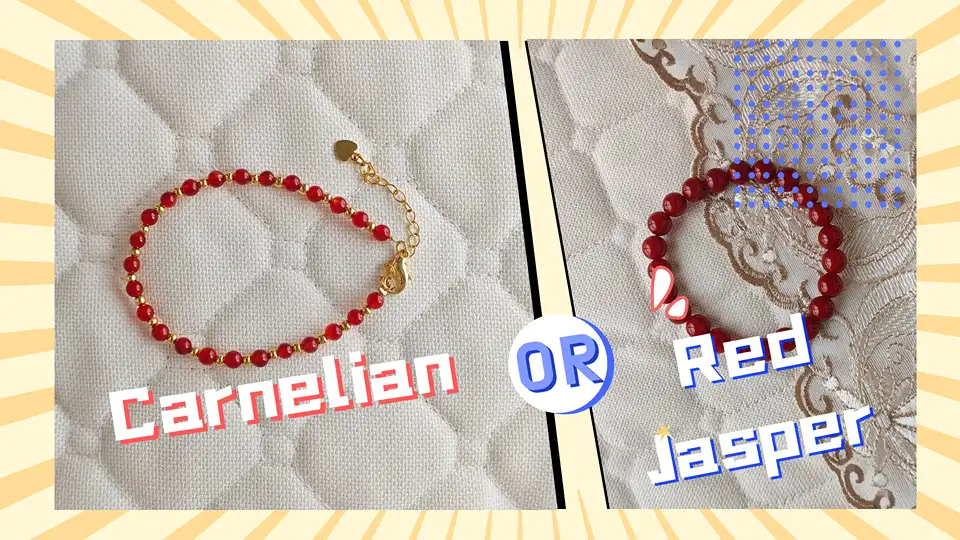
Our Carnelian Bracelet
4 mm natural carnelian beads, hand-strung with color-preserving gold accent beads and finished with an adjustable lobster clasp and extender chain (approx. 6–7.5 in / 15–19 cm). Warm orange-red tones that glow at the edges.