Short Answer: Three Blue Stones, One Care Test
Put these three side by side on a shelf and they share a color and a price range. Almost nothing else lines up.
The fastest way to separate them is a single question: can you wash your hands wearing it. Aquamarine, yes, rinse and dry. Blue topaz, yes, hardness 8 takes daily water without complaint. Turquoise, no: it is porous, it absorbs water, oil, and sweat, and then it changes color.
If what you want is a bracelet you can cook, clean, and leave the house in, the answer is already sitting in the water row.
If this is your first bracelet and you want the basics first, start with What Are Crystal Bracelets?.
What Is Aquamarine?
Aquamarine is a member of the beryl family, the same family as emerald, with the chemical makeup of a beryllium aluminum silicate. Its blue comes from traces of iron in the crystal structure, and the color runs from nearly colorless through pale blue into blue-green. Deep, saturated natural aquamarine is genuinely scarce.
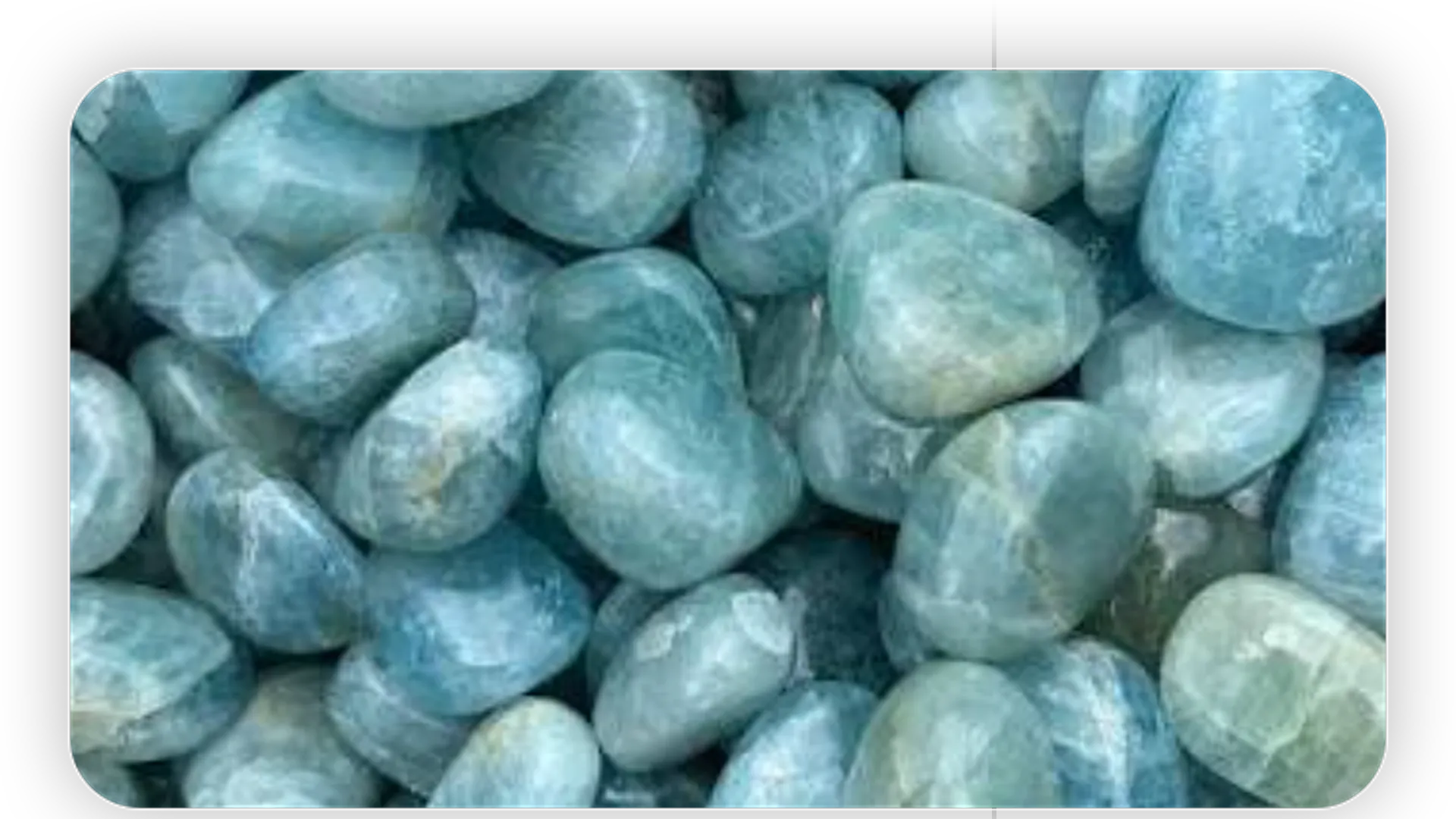
It rates 7.5 to 8 on the Mohs scale, with a specific gravity of 2.68 to 2.74, a vitreous luster, and usually high clarity, sometimes with fine tubular inclusions. It is the traditional birthstone for March.
It is also the lowest-maintenance stone of the three. Daily rinsing and drying is fine, and only long soaking needs to be avoided. Our own aquamarine bracelet follows that standard: avoid prolonged exposure to water, apply fragrance before wearing, store separately when not worn, and wipe gently with a soft cloth.
What Is Blue Topaz?
Blue topaz is topaz, an aluminum silicate, at 8 on the Mohs scale with a specific gravity of 3.49 to 3.57, a vitreous luster, and usually very high clarity.
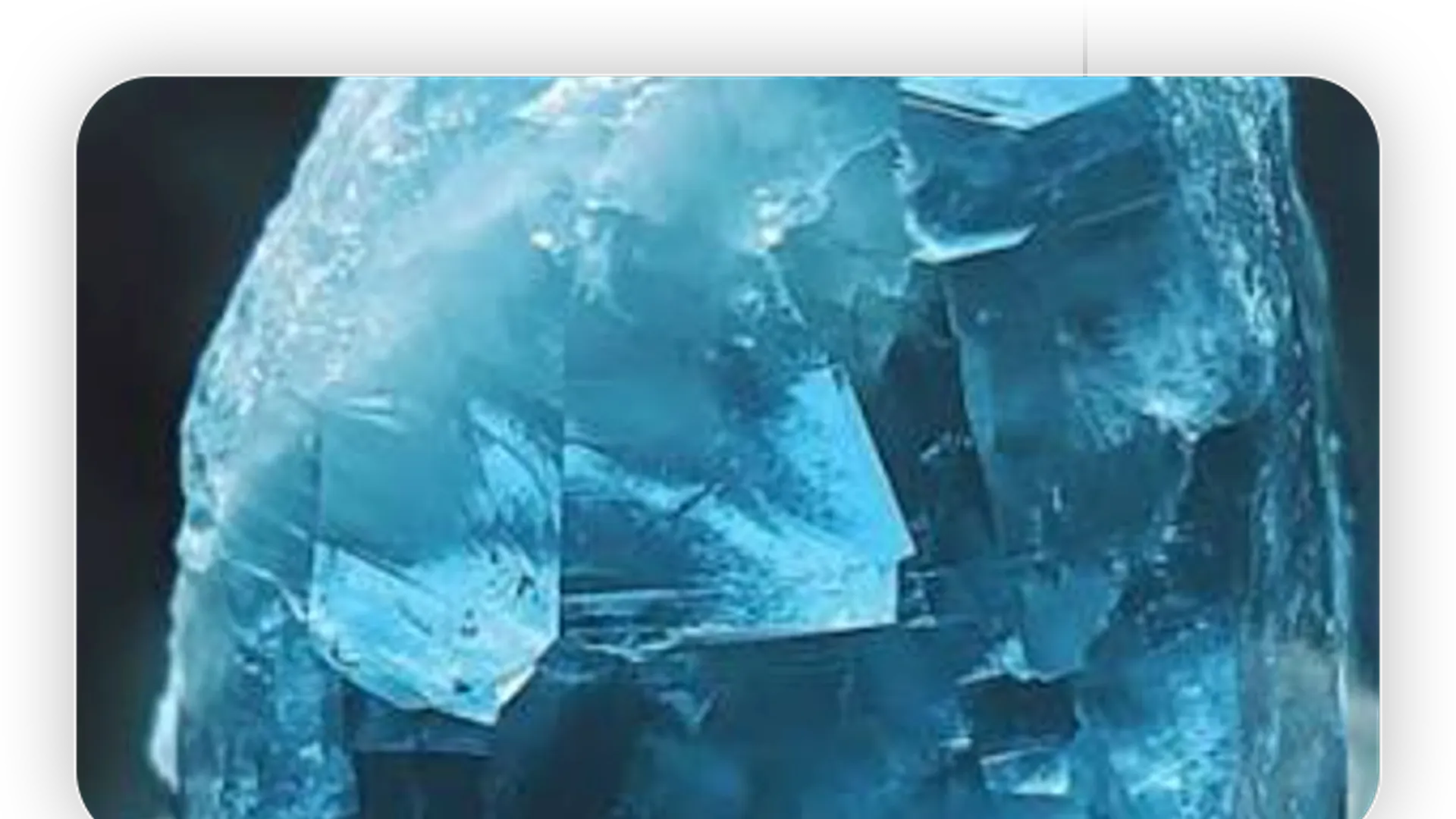
One thing has to be said first: natural deep blue topaz is extremely rare. The blue topaz on the market today starts as colorless topaz, irradiated and heat-treated into blue, then graded by saturation into sky, Swiss, and London.
That treatment is permanent, stable, industry standard, and required to be disclosed to buyers. So blue topaz is not a fake: it is genuine natural topaz whose color comes from processing. The claim that does not survive contact with today's market is "natural deep blue topaz," and any seller making it should be asked directly.
It also has two physical weak points worth remembering. It has a perfect basal cleavage, so one hard knock can split it along that plane. And long-term UV exposure slowly fades the treated blue. Most damage happens during cleaning rather than during wear, which is why ultrasonic cleaners and steam are off the table.
What Is Turquoise?
Turquoise is a hydrated copper aluminum phosphate, at only 5 to 6 on the Mohs scale, with a specific gravity of 2.3 to 2.9, a waxy luster, and an opaque to translucent body.
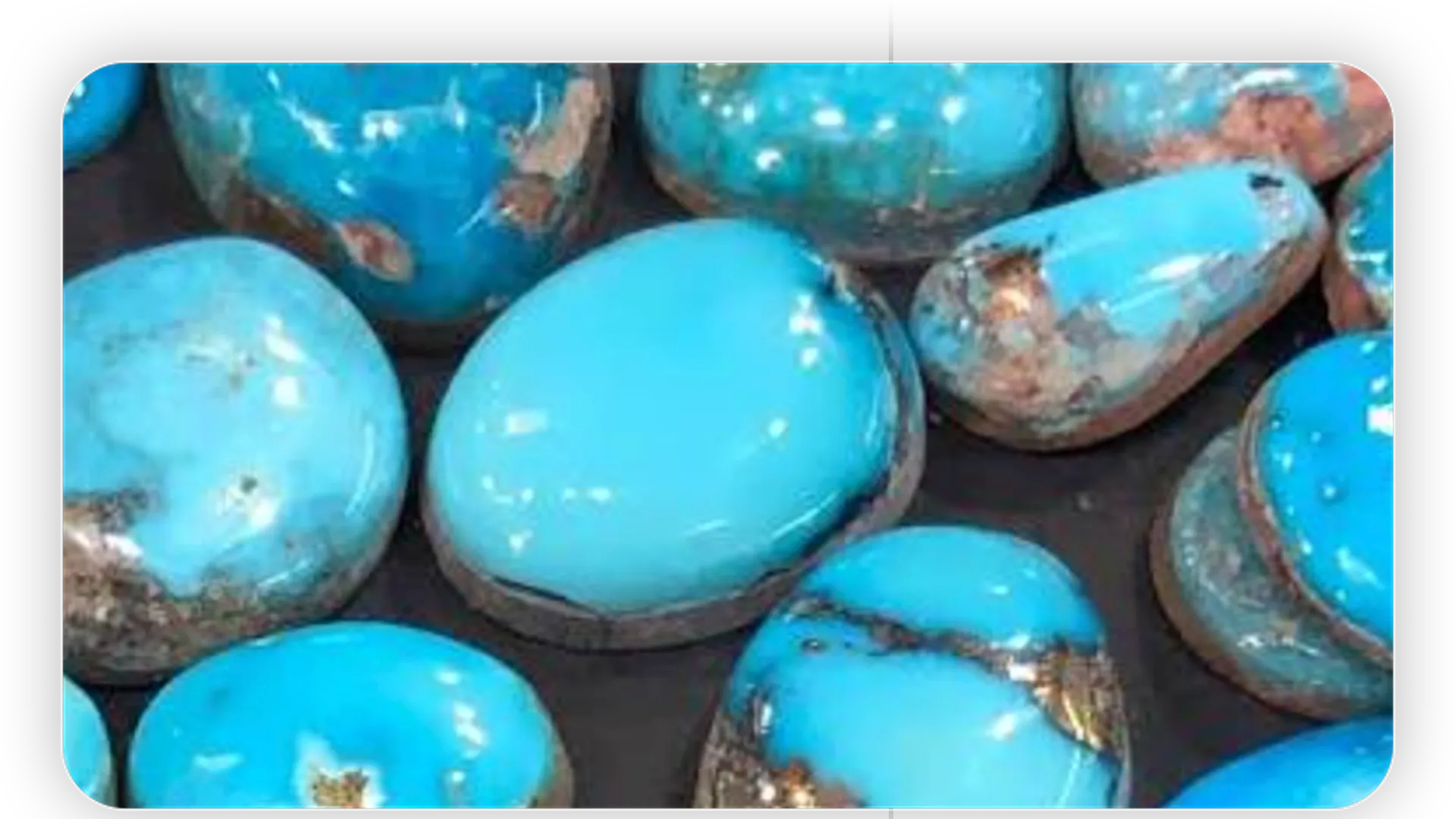
It is the most reactive of the three: porous, it absorbs water, oil, and sweat, and it can be shifted by chemicals and sunlight. The brown or black web of matrix running across its surface is not a flaw. It is a defining feature of turquoise and one of the ways the stone is identified. The more even the color and the scarcer the matrix, the more expensive the stone usually is, but evenness alone does not prove anything natural, and that layer is beyond this article's scope.
In care terms it is the only one of the three that must never be washed: dry cloth, stored separately, away from light and damp. Soaking turquoise in water to "cleanse" it is the single most damaging habit you could pick among these three blue stones.
Side by Side
Aquamarine | Blue Topaz | Turquoise | |
What it is | Beryl family | Topaz | Hydrated copper aluminum phosphate |
Crystal system | Hexagonal | Orthorhombic | Triclinic |
Mohs hardness | 7.5–8 | 8 | 5–6 |
Specific gravity | 2.68–2.74 | 3.49–3.57 | 2.3–2.9 |
Luster | Vitreous | Vitreous, usually brighter | Waxy |
Transparency | Transparent to translucent | Usually high-clarity transparent | Opaque to translucent |
Color origin | Natural, trace iron | Deep natural blue extremely rare; market stone almost all irradiated and heated | Natural blue-green, often with matrix |
Industry treatment | Mostly untreated or lightly heated | Irradiation and heat, standard and disclosed | Commonly filled and stabilized |
Main risk | Hard impact | Cleavage splitting, temperature swings, UV | Water, sweat, oil, chemicals, sunlight |
Water safe | Yes, rinse and dry | Yes, no ultrasonic, no steam | No, will discolor |
Birthstone | March | December, added 2002 | December, traditional |
Five Elements (our store) | Water | Not carried | Not carried |
Read down the table and three rows decide your purchase: color origin, specific gravity, and water safety. The first two determine what you are actually buying. The third determines how long you can keep wearing it.
There is a trap in the hardness row. Blue topaz is the hardest of the three at 8, and it is also the one most likely to split from a single knock, because of that perfect cleavage. Turquoise is the softest at 5 to 6 and has no such weakness. "Harder means more durable" does not hold across these three.
Where the Color Comes From: One Natural, One Processed
This is the part of the comparison worth reading twice.
Aquamarine's blue is natural. It comes out of a beryl crystal, colored by trace iron, mostly untreated or lightly heated to remove yellow and brown modifiers. The color you see is the color the stone grew.
Blue topaz's blue is almost entirely made. Natural deep blue topaz is rare enough to ignore at market scale, and the industry takes colorless topaz, irradiates and heats it into a stable permanent blue, and grades the result into sky, Swiss, and London.
The line that matters: this treatment is industry standard, and it must be disclosed to buyers. Buying blue topaz is not buying a fake, but you are entitled to know the color came from processing. Any seller who presents treated blue topaz as natural deep blue is dodging a disclosure obligation.
Turquoise's blue is natural, and its surface is the most likely to be altered. Filling, stabilization, and dyeing are all common in this category. A starting judgment is the matrix: natural matrix wanders irregularly and varies in depth, while a surface that is too even, too saturated, or too neatly webbed is worth a direct question.
The Weight Test: No Tools Needed
If you are holding two same-size beads, one aquamarine and one blue topaz, there is a way to separate them in three seconds: weigh them in your hand.
Topaz has a specific gravity of 3.49 to 3.57. Aquamarine sits at 2.68 to 2.74. At the same size, topaz is roughly 30 percent heavier. The heavier one is topaz, the lighter one is aquamarine.
This is the most usable test in the article, because it needs no tools and no expertise. The only requirement is that the two beads be close in size; too big a gap and the difference stops being feelable.
Which One Survives a Wrist?
Aquamarine, 7.5–8 | Blue topaz, 8 | Turquoise, 5–6 | |
Daily wear | Friendly | Friendly, avoid hard knocks | Needs care |
Main risk | Hard impact | Cleavage splitting, temperature swings, UV | Water, sweat, oil, chemicals, sunlight |
Cleaning | Soft cloth | Warm water, mild soap, soft cloth. No ultrasonic, no steam | Dry cloth only, no water |
Storage | Store separately | Store separately, away from harder stones like diamond or sapphire | Store separately, away from light and damp |
Lined up together, the three produce a counterintuitive result. The hardest stone, blue topaz, is the one most afraid of impact. The softest, turquoise, has no such weakness but cannot tolerate water. And the one in the middle, aquamarine, avoids both extremes, which makes it the easiest of the three to live with.
For a stretch-cord bracelet, none of the three should be soaked for long regardless of stone, because the cord fails first. For the fuller routine, see our guide to cleansing and charging a crystal bracelet.
Energy and Intention
All three sit on the same broad line of tradition, the line about settling down, but they land in different places.
Aquamarine is traditionally associated with calm, clarity, and communication, often described as the stone for saying the thing clearly.
Blue topaz is traditionally associated with clarity, focus, and a clear mind, with a brighter and cooler temperament than aquamarine.
Turquoise is traditionally associated with protection, a sense of restoration, and connection to the land. It is the earthiest of the three, warm and grounded rather than clear and cool.
In our store, aquamarine belongs to Water in the Five Elements framework, carrying flow, intuition, reflection, and adaptation. Blue topaz and turquoise have no Five Elements position in our store, and this article will not invent one. If you want to know which element fits you, our Element Quiz takes about a minute.
Which One Should You Choose?
Choose aquamarine if you want natural color and low maintenance. Its blue is the color it grew, 7.5 to 8 is enough for daily wear, and brief contact with water is fine. It is the least demanding of the three, and it is the only one we carry.
Choose blue topaz if saturation and budget come first. At the same size it is heavier and brighter, the deep blue is beyond what natural aquamarine gives, and it usually costs less. The trade-offs are the processed color and that cleavage plane: no knocks, no ultrasonic, no long sun exposure.
Choose turquoise if what you want is that opaque, warm, matrix-webbed surface, and you are willing to change your habits for it. It is the only one of the three that cannot touch water, and the one that most needs its own storage. Before you choose it, answer one question honestly: can you take it off to wash your hands.
To be plain about it: we do not carry turquoise, and we do not carry blue topaz. Aquamarine is our blue.
If your instinct points toward one of the two we do not have, the nearest thing in the shop is Green Aventurine, another low-saturation natural blue-green, Wood rather than Water, and it pairs with aquamarine in our Tide, Wood & Flame bundle.
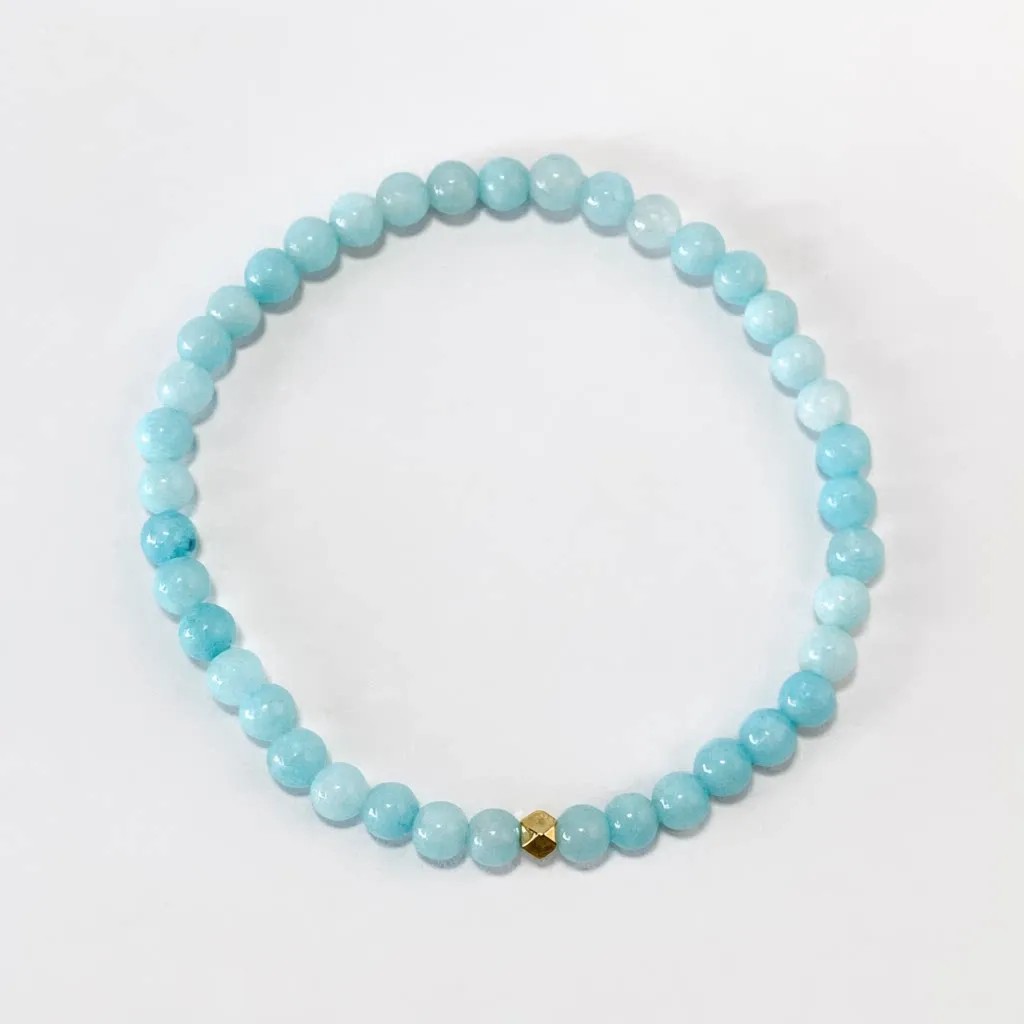
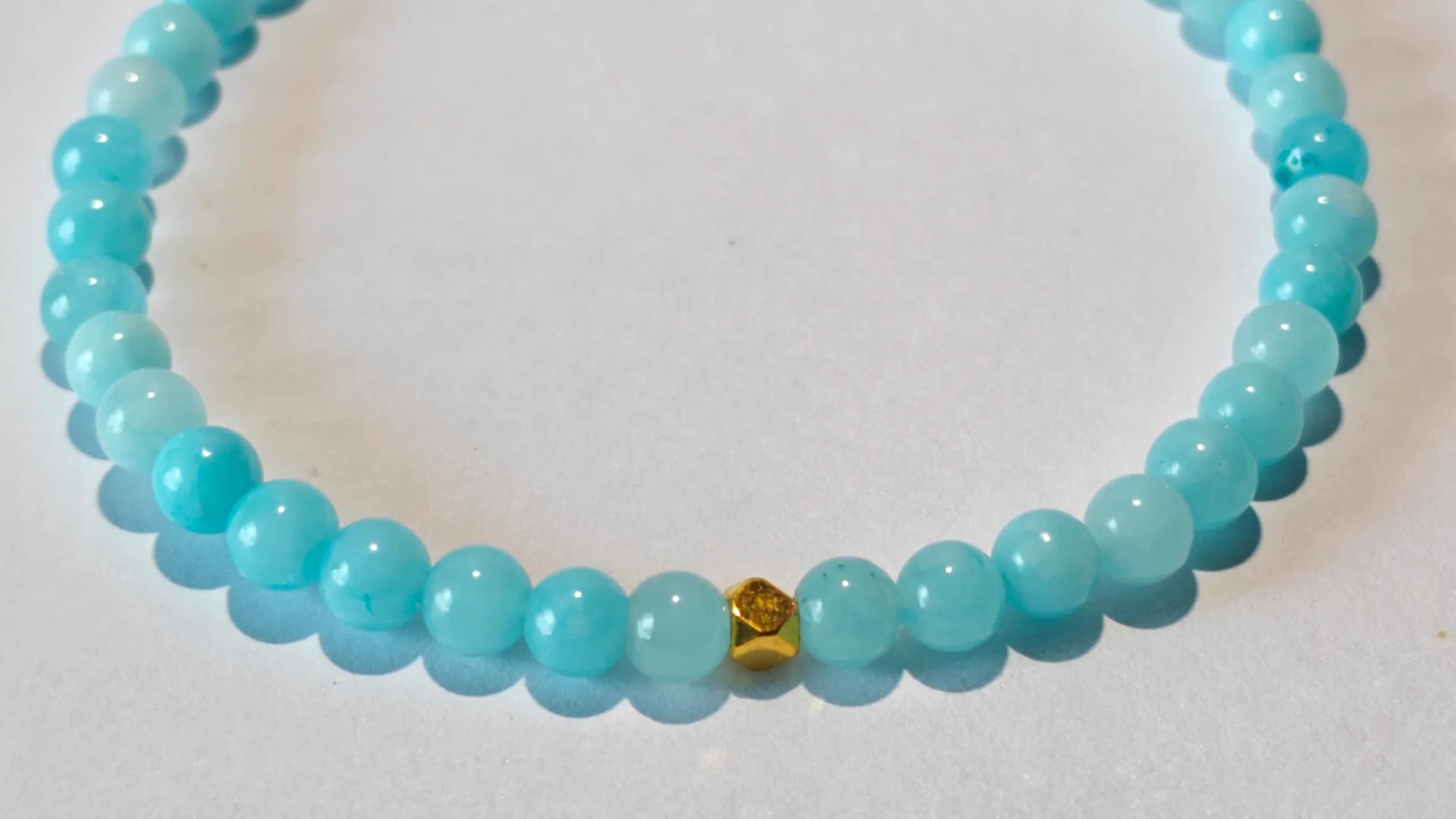
Our Aquamarine Bracelet
4 mm natural aquamarine beads on a durable stretch cord, sized to fit most wrists at about 7 in / 18 cm. Pale to blue-green natural tones, Water element.