Short Answer
Agate and quartz are the same chemistry, silicon dioxide (SiO₂), and the difference is whether the crystal grew large enough to see. Quartz grows visible six-sided prisms. Agate's crystals are too small to see without a microscope, so it grows no crystal faces at all, only layers of banding. Hardness and specific gravity are nearly identical: 6.5 to 7 against 7, and 2.6 against 2.65. That kills two home tests at once: scratching proves nothing, and weighing proves nothing. The one reliable check is form: crystal faces and terminations mean quartz, banding means agate.
Agate vs Quartz: What's the Difference?
One chemistry, two crystal scales.
Quartz is macrocrystalline: silicon dioxide gets the time and space to grow crystals you can see, the six-sided prisms with pointed terminations you see in a mineral case. Rock crystal, amethyst, citrine, and smoky quartz all wear that form.
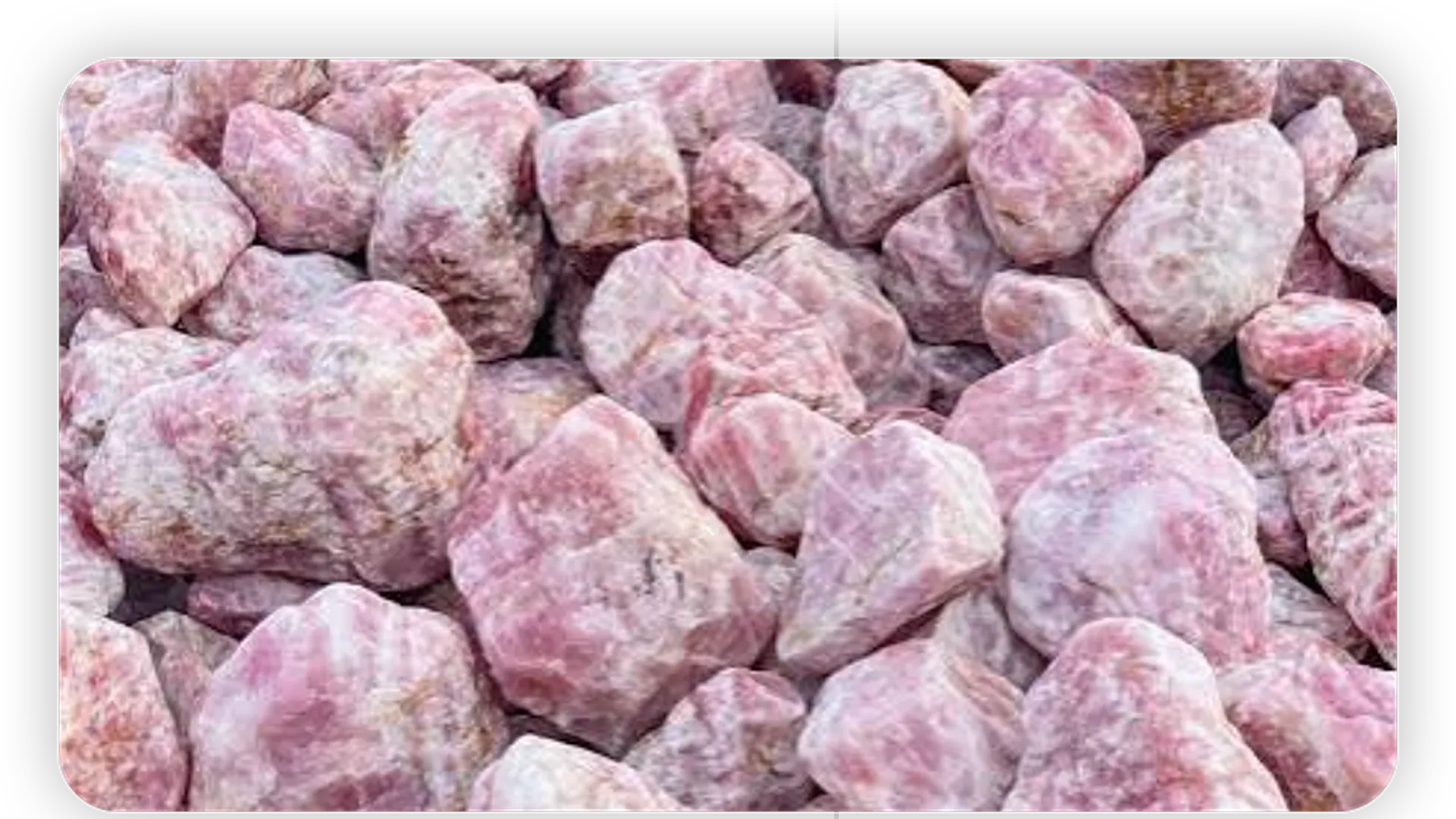
Agate is cryptocrystalline: silicon dioxide deposits layer after layer along a cavity wall fast enough that each layer is buried before its crystals can grow, leaving crystals too small to see without a microscope. Agate therefore never grows crystal faces. Its identity lives entirely in the banding: stripes, concentric layers, eye patterns.
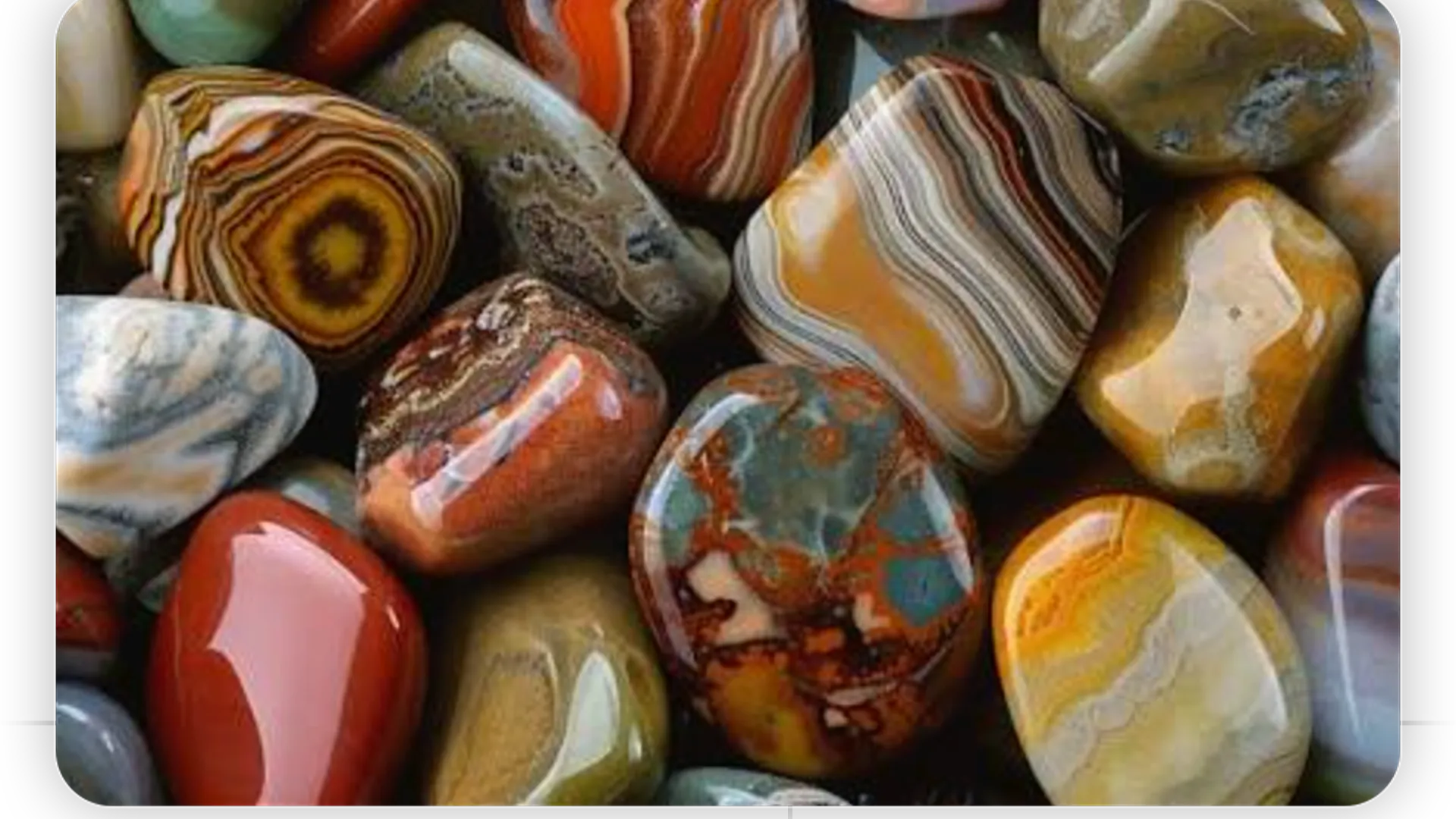
The cryptocrystalline branch as a whole is called chalcedony, and agate is the banded, light-passing cell inside it. So is agate a quartz? Yes, but it is the cryptocrystalline branch of quartz, the same chemistry as amethyst in a different form. The next section takes that apart.
Side by Side
Agate | Quartz | |
Chemistry | SiO₂ | SiO₂ |
Crystal structure | Cryptocrystalline (chalcedony) | Macrocrystalline |
Crystal system | Trigonal, no visible crystal form | Trigonal, six-sided prisms with terminations |
Mohs hardness | 6.5 to 7 | 7 |
Specific gravity | Around 2.6 | Around 2.65 |
Transparency | Translucent at the edges | Transparent to translucent |
Fracture | Conchoidal | Conchoidal |
Common form | Bands, concentric layers, eye patterns | Single crystals or clusters of six-sided prisms |
Typical members | Red agate, blue agate, moss agate | Rock crystal, amethyst, citrine, smoky quartz |
Five Elements (our store) | Fire (red agate) | By variety: Water (amethyst), Earth (citrine), Metal (rock crystal) |
Read from the top and the first row says it all: the chemistry is identical. What actually separates the two is the crystal structure row, and the common form that follows from it: a six-sided prism with a termination versus a mass with bands. Hardness, specific gravity, and fracture all overlap, which is exactly why scratching and weighing fail.
Is Agate a Quartz?
Asked as agate vs quartz, the question sounds like a comparison of two minerals. It is really a question about one mineral wearing two forms.
Yes, and that yes is worth unpacking, because it is the foundation of the whole article.
Agate belongs to the cryptocrystalline branch of the quartz family, collectively called chalcedony. It is the same chemistry as amethyst, rock crystal, and citrine (SiO₂) in a different form: macrocrystalline quartz grows crystals you can see, while cryptocrystalline agate grows no visible crystal form at all, only the banding left by layer-by-layer deposition.
Why does one chemistry produce two forms? Growth environment. When silica-rich fluid enters a cavity with stable space and time, silicon dioxide stacks into visible crystals. When it deposits rapidly along the wall of a volcanic cavity, each layer is buried before it can crystallize, and the result is chalcedony, with the banded kind being agate.
That also answers a common side question: why agate keeps company with geodes. The wall of a geode is often lined with layers of agate, the product of the same batch of silica-rich fluid. The geode is the container, the agate is the lining, and they are not two different stones.
If your goal is a purchase decision, one line is enough: agate is quartz, but the "quartz" you see in shops, usually rock crystal, and agate are two looks of one chemistry that the trade often prices and names in two separate systems.
The Quartz Family Map
Draw the whole quartz family and agate's position becomes obvious.
Quartz (SiO₂) splits by whether the crystal is visible to the eye:
- Macrocrystalline: rock crystal, amethyst, citrine, smoky quartz. Anything that grows a six-sided prism belongs here.
- Cryptocrystalline (chalcedony): splits again on banding and light transmission:
Banded | Not banded | |
Translucent, light at the edges | Agate | Carnelian |
Opaque, blocks light completely | Onyx sits here | Jasper |
The upper half of this map, macrocrystalline quartz, is where rock crystal, amethyst, and citrine live. The lower half is the chalcedony family, where agate belongs. For the full internal comparison of the four chalcedony cells, see Agate vs Jasper, and for the red family specifically, see Red Agate vs Carnelian. Anyone searching chalcedony vs quartz is asking for this two-level map: chalcedony is the cryptocrystalline branch of quartz, not a mineral outside it.
How to Tell Them Apart in the Field
Check 1: Look for crystal faces. Six-sided prisms and terminations mean quartz. No crystal faces, only bands or a featureless mass, means agate. This check costs nothing and cannot fool you.
Check 2: Read the banding. Hold the stone to a strong light and turn it slowly. Stripes or concentric layers mean agate; uniform color or crystal faces mean quartz. Agate's bands are continuous and directional, so do not read impurity streaks as banding.
Check 3 (raw form): Look at the whole piece. Quartz in the raw typically shows as single crystals or clusters, six-sided prisms with terminations. Agate in the raw typically shows as botryoidal or nodular cavity linings, with the banding only visible once it is cut. A prism with a point and a cut-open layered ball are the two most typical raw looks of these stones.
Why the scratch test fails. Agate sits at 6.5 to 7 and quartz at 7. The gap is too small for either to scratch the other, and a scratch on a polished bead is permanent. The hardness numbers are a mineralogical fact, not a home test.
Why weighing fails. Agate runs around 2.6 in specific gravity and quartz around 2.65. At the same size the difference sits inside the margin of error. If you searched agate vs quartz hoping for a weight or scratch test, read the form instead.
Which One Should You Choose?
Choose agate if you want banding and layering. It changes as you turn it, which makes it visually richer. Our banded piece is red agate, Fire in the Five Elements, carrying vitality: Red Agate bracelet
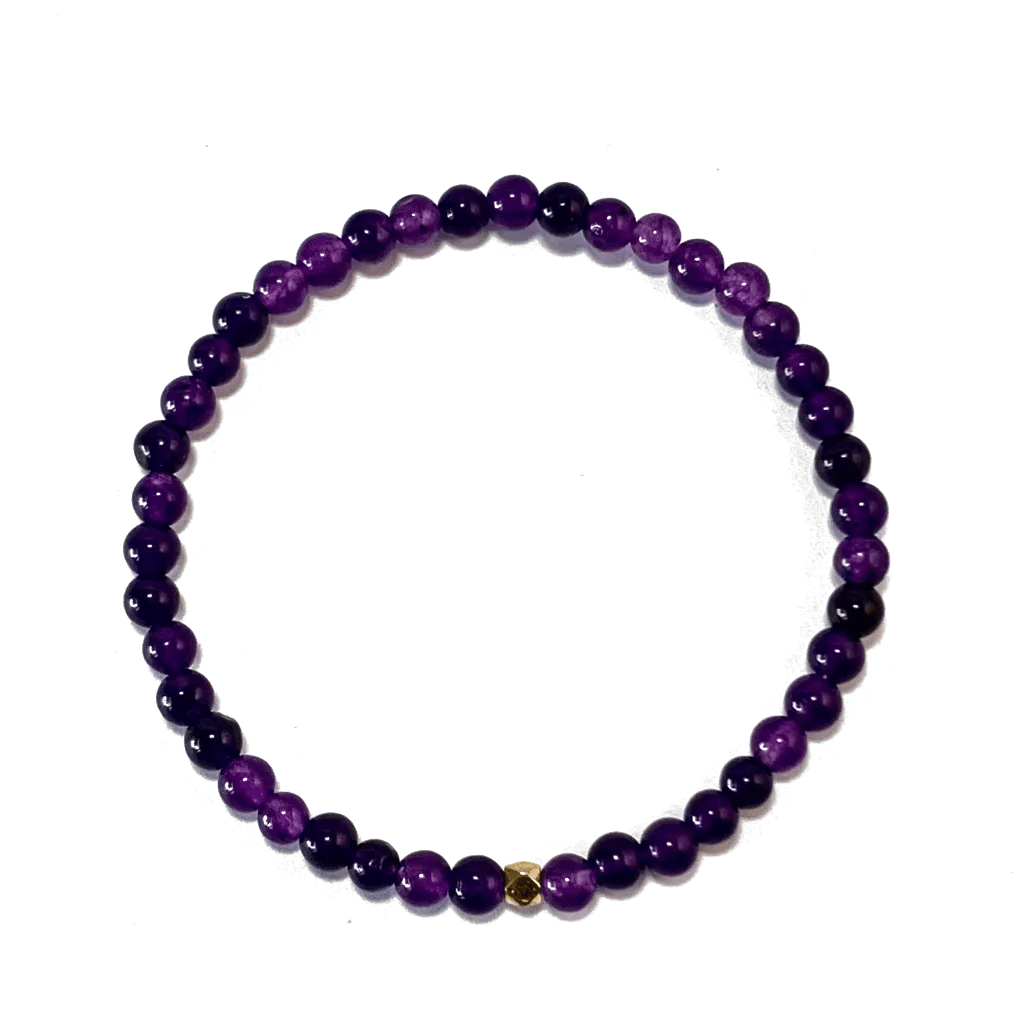
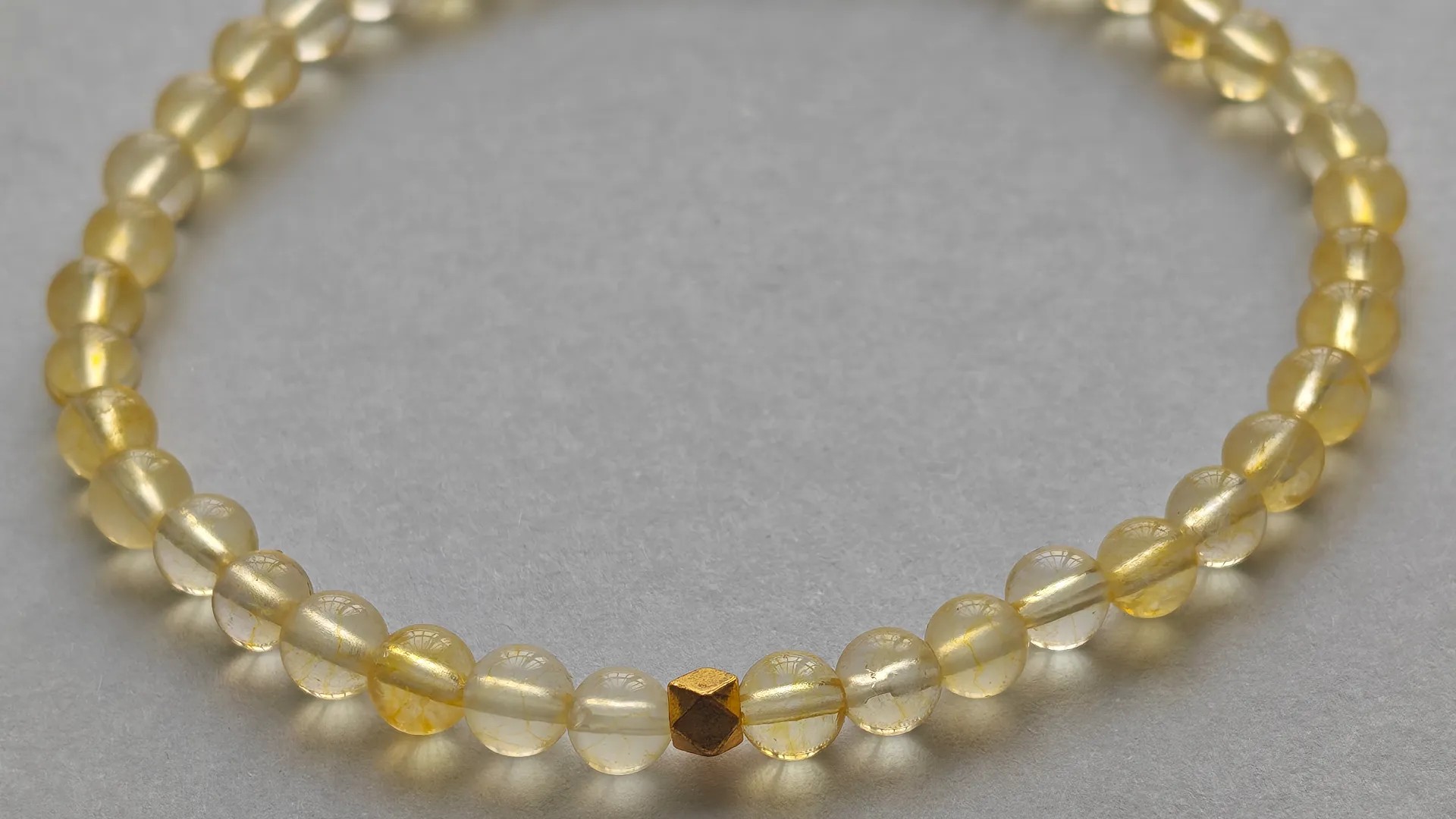
Choose quartz if you want crystal faces and clarity. For the quiet purple, amethyst, Water in the Five Elements: Amethyst bracelet. For the warm gold, citrine, Earth. Both sit on the macrocrystalline side: the crystal had room to grow, so it grew faces.
Wearing both is reasonable too. The hardness is nearly identical, so neither scratches the other, and banded next to crystalline reads as layering rather than repetition.
If you are not sure which element fits you, our Element Quiz takes about a minute.
Our Banded and Crystalline Bracelets
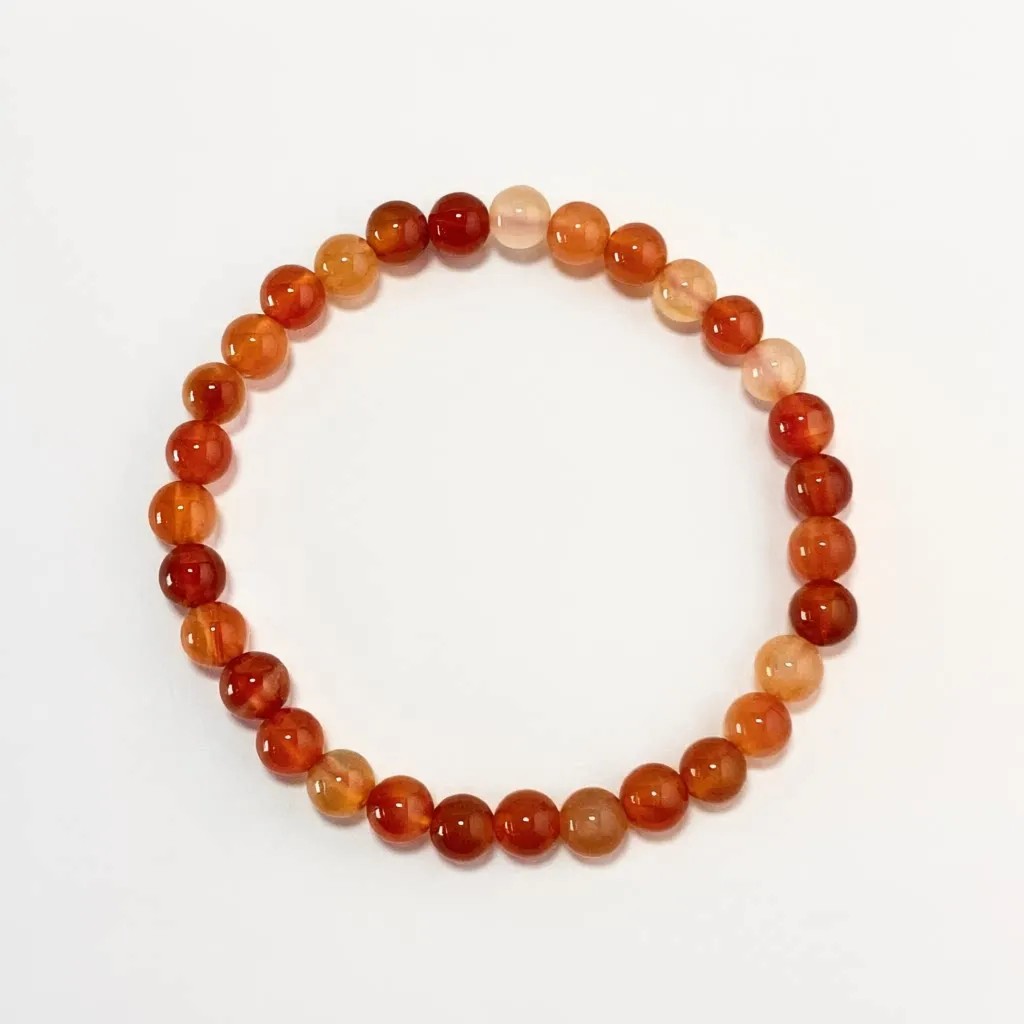
Red Agate Bracelet (banded): 6 mm or 8 mm natural red agate beads on a durable stretch cord, sized to fit most wrists at about 7 in / 18 cm. Deep layered red tones with natural banding and subtle variation from bead to bead. Fire in the Five Elements.
Amethyst Bracelet (crystalline): 4 mm or 8 mm natural amethyst beads on a durable stretch cord, sized to fit most wrists at about 7 in / 18 cm. Natural purple tones. Water in the Five Elements.